
Summary
The Caltrans Truck Access Study has released some findings. The findings show that the truck ban on I-580 should be retained because, if the truck ban is repealed, the damage imposed on the people who live close to I-580 and SR-13 will be huge compared to any benefit that may accrue to the residents along I-880 and I-238. It is time for Caltrans to terminate the study and to abandon the misguided proposal to allow heavy trucks to use I-580 to cut through the residential heart of the East Bay.
Instead of wasting effort on the truck ban, we recommend that Caltrans and the Bay Area Air District (BAAD) concentrate on how to help the Equity Focus Areas in the East Bay. BAAD has, through over a decade of focused attention, achieved excellent results in West Oakland, as illustrated by the improvement in CalEnviroScreen scores (see Figure 3, below) and the West Oakland Environmental Indicators Project 5-year report (see Figure 2, below). The agencies should continue this attention on West Oakland, and apply the same level of focus to East Oakland and to the other Equity Focus Areas that have not been specifically addressed to date.
To download this page as a PDF, please click here:
The Findings
We reviewed the findings of the Caltrans Truck Access Study that have been released to date. There are about 100 pages of findings released so far, including a summary provided in the “Equity ToolKit”. We have reviewed and summarized the documents so that you do not need to read them all. We have divided the discussion below into two categories:
- Interpretation and Opinion, which is our view on how the findings apply to the decision on whether or not to repeal the truck ban, and
- Facts, as contained in the technical memos released by Fehr and Peers (F&P, Caltrans’ engineering consultant), supplemented by the demographic data in the Skyrak Demographics Report.
The Caltrans documents released to date are:
https://apps.fehrandpeers.com/i580_equity_explorer/ (the Equity Toolkit)
https://apps.fehrandpeers.com/i580_equity_explorer/memos/traffic-memo.pdf (the traffic analysis memo)
https://apps.fehrandpeers.com/i580_equity_explorer/memos/air-quality-memo.pdf (the air quality analysis memo).
Interpretation and Opinion
Based on our review of the Caltrans Findings it is the opinion of NoBigRigs580.org that the findings support leaving the truck ban in place. Note that we have not yet seen the detailed results of the Caltrans Noise Analysis, nor the Equity Analysis. We will update this section of our web site if and when those findings are released by Caltrans, and we have reviewed them.
- The benefits of removing the Truck Ban are small compared with the costs imposed on the residents of the I-580 and SR-13 corridors.
- The only significant benefit of removing the truck ban is an improvement in truck travel times and truck speeds. The only beneficiary is the trucking industry. The people of Oakland, San Leandro, Berkeley and the unincorporated areas of Alameda County do not benefit – and in most cases, suffer the costs.
- The number of trucks per day on I-880 and I-238 are projected to reduce by 35% and 55% respectively if the truck ban were to be repealed. While these reductions are significant, they will not make a substantial change to the nature of the highway and its industrial corridor. By contrast, the number of trucks on I-580 and SR-13 will increase by 4,400% and 125% respectively. These changes will make a massive difference to the highways and their residential corridors. Moreover, Ashby Avenue and Tunnel Road in Berkeley will see a 160% increase in truck traffic, which will have a major effect on these residential streets.
- Truck traffic on some local streets is expected to significantly increase, impacting safety of local residents and impairing roadway integrity, of which Caltrans takes no responsibility.
- The health benefits that may accrue to West Oakland and East Oakland are so small as to be close to the margin of error of the study.
- Removing the truck ban will just move some truck traffic from one Equity Focus Area to another, more densely populated, Equity Focus Area. This clearly would not be good public policy. This is obvious from the data – we are puzzled why Caltrans has not stated the same conclusion.
- Caltrans has not conducted a robust noise analysis and would like us to believe there would be no impact if the truck ban were repealed.
The Equity Toolkit contains the following paragraph:
“Removing the truck ban would likely increase noise on I-580 by less than 1.5 dB(A) and decrease noise slightly on I-880 and I-238 as trucks shift routes. “Changes in noise less than 3 decibels are generally too small to be noticeable.” (emphasis by Caltrans).
When Caltrans stated in public meetings that I-580 residents would not be able to notice the increased noise associated with 4,400 additional trucks per day, the reaction was amazed laughter. There are two problems with the Caltrans statement:- No data has been presented to back up this statement (in fact the Caltrans description of the scope of the Noise Analysis described a highly superficial assessment of noise in two or three small segments of highway, with no account made for hills, curves or local topography); and,
- The many residents who live close to I-580 can hear the trucks and buses that travel on the freeway now. As reported to the TAC, some of the highest noise levels in the Study Area are along I-580.
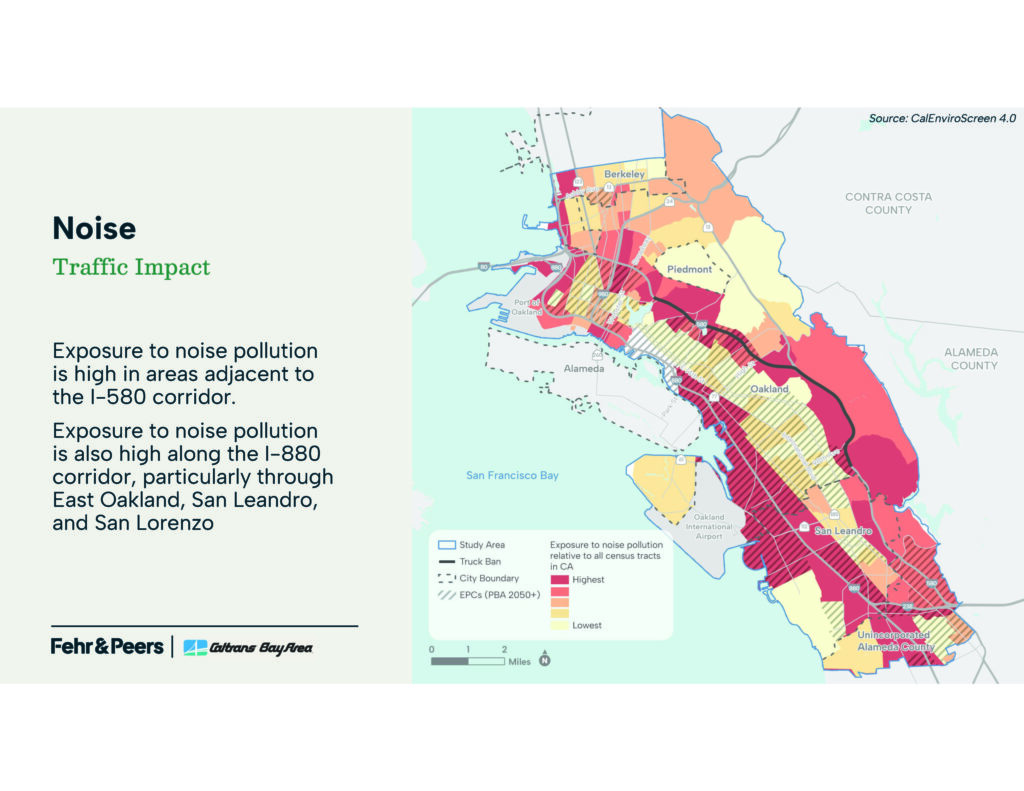
Figure 1: Noise Pollution along I-580 as presented to the Caltrans Truck Access Study Technical Advisory Committee on February 17, 2026.
We think that Caltrans is attempting to minimize the noise problem, instead of conducting a comprehensive noise analysis.
- Caltrans does not mention that its own consultant recommends studying the risks to public safety.
Fehr and Peers (F&P), the Caltrans consultant who is conducting the Truck Access Study, has recommended that a further study be conducted to evaluate the risks of more severe truck-involved accidents if the truck ban is lifted. This recommendation has not been mentioned by Caltrans in the Equity Toolkit, or in the public statements and presentations that Caltrans has made describing the findings of the study. See, for example, the Caltrans presentation to the Alameda County Transportation Commission on July 23, 2026. We are concerned that this important recommendation may be buried.
- Caltrans “spin” of the Study results appears to support a predetermined outcome.
In many cases in the Caltrans and Fehr & Peers documents, the conclusions seem to not align with the data. Some people have held a suspicion that the outcome of the Truck Access Study was predetermined to result in a recommendation to overturn the truck ban, and there is some evidence to support this thesis. Here are some examples that indicate a possible bias:- Traffic Analysis Table 28:
In this table, F&P examine several parameters, such as “Amount of heavy truck traffic traveling through the study area”, and make an assessment of whether or not the results support the removal of the truck ban. In their assessment, they consider only the total number of trucks passing through the area (which they found does not change significantly), and do not consider that by moving trucks to I-580, the impact is felt by far more people. They ignore this fact because their demographic analysis is too imprecise to calculate the number of residents close to each of the highways. It appears that the Caltrans study was designed to ignore the fact that more people live along I-580 than along I-880. The conclusions of the study are consistently biased by the study’s lack of knowledge of the demographics. See the Skyrak Demographics Study for a more detailed demographic analysis. - TAC Meeting Minutes:
- Meeting #2, February 17, 2026.
Justin Taschek, Port of Oakland: “Can a few metrics be spun up as a benefit? For example, on slide 12, we see that there is a reduced delay for both vehicles and trucks.”
….
Kristen Villanueva, Alameda CTC: “Notice that traffic flow to Port of Oakland is low. And 80% of traffic through 580 is pass through. Looking at the truck traffic performance measure, why do we say there is a minimal impact on ‘Truck Traffic Traveling through the study area’ if truck traffic increases on 580?”
- Meeting #2, February 17, 2026.
- Minimization of the traffic noise problem as described in Section 4, above.
- Traffic Analysis Table 28:
- Caltrans will not acknowledge impacts on I-580 from “Induced Travel”
Caltrans and F&P have stated that opening up additional lanes to truck traffic (along I-580) will not result in additional truck journeys, and therefore induced travel has not been factored into the traffic analysis. But on page 64 of the Traffic Analysis Memo, F&P states that the reason that the truck traffic on I-580 (without the truck ban) decreases from 4,500 trucks per day in 2026 to 3,800 trucks per day in 2035 is because of increased congestion on I-580:
- “Given the expected increase in volumes by 2035 along the clean policy environment future consideration, increased congestion in the study area is expected. Therefore, trucks that have the possibility to avoid the study area altogether (e.g., choosing other routes) could choose alternative routes, resulting in lower volumes on study area freeways.”
This is the converse of induced travel – when congestion on one route increases, trucks will find other routes, if they can. Given that over 80% of projected truck traffic on I-580 has an origin or destination outside the area, I-580 truck traffic is influenced by this type of route flexibility. The question is: If induced travel works when I-580 becomes more congested, why doesn’t it apply when truck lanes are suddenly opened up on I-580 if the truck ban is repealed? The traffic analysis seems to be inconsistent on this issue, and therefore the entire traffic analysis is now in question.
- Caltrans has Acknowledged that the Current Study is Incomplete.
Caltrans acknowledges, in the Equity ToolKit, that the following issues need further study before a recommendation to repeal the truck ban can be made:
- Could lifting the truck ban increase seismic risk?
- Could lifting the truck ban change evacuation times or routes?
- Is I-580 structurally able to handle trucks?
We believe that there is sufficient evidence already to leave the truck ban in place and stop the Caltrans Study, but if the State decides to press forward, we would add the following to this list:
- Truck Collision Safety Assessment (as recommended by F&P, pages 5 & 60 of traffic analysis).
- I-580 Infrastructure Analysis (as recommended by F&P, page 35 of traffic analysis)
- Emergency vehicle access to hospitals.
- On/Off ramp evaluation for heavy trucks
- Speed limits on I-580 Grand Avenue curve. (Curve radius is tighter than Caltrans standards).
- Evaluation of the effect of heavy trucks on the westbound merge of I-580, I-980, and SR-24, and the merge between westbound I-580 and eastbound I-80. All of this will be complicated by the new westbound carpool lane on I-580 starting at Grand Avenue.
- Comprehensive noise analysis and mitigation assessment, especially at the Park Boulevard Grade (I-580), and the Redwood Road grades (SR-13).
- Update the Traffic Analysis to include induced travel.
In the unlikely event that Caltrans recommends that the truck ban be lifted, we would expect that Caltrans will perform an Environmental Impact Analysis, including a comprehensive benefit-cost analysis.
Facts
- The damage as a result of removing the truck ban would consist of:
- 4,500 trucks per day on I-580 compared with 100 trucks per day currently. The number of trucks per day would reduce to 3,800 per day in 2035 due to increased congestion on I-580 that results in out-of-area trucks choosing a different route. Note that over 80% of the truck journeys forecast to travel on I-580 have origins or destinations outside the Caltrans Study Area – they are not local.
- 900 trucks per day on the Warren Freeway (SR-13), compared with 400 today.
- 440 trucks per day on Tunnel Road (SR-13), compared with 170 today.
- 310 trucks per day on Ashby Avenue (SR-13), compared with 120 today.
- 500 trucks per day on 150th Street compared with 110 today.
- 490 trucks per day on Hesperian Boulevard, compared with 50 today.
- Higher truck speeds on I-580 could lead to more severe truck-involved accidents. F&P recommends further study of the safety aspects of removing the truck ban.
- Higher noise levels close to I-580 and SR-13. (The Caltrans noise analysis was not sufficiently detailed to develop accurate noise level estimates, so we don’t know just how damaging the noise will be).
- Traffic delays on I-580 will increase. The Study found that the average number of passenger hours delayed per day on I-580 would increase from 1,850 to 2,050, an increase of 200 hours per day. Note this data is for an average day, which includes weekends and holidays. Fehr and Peers described this increase as “negligible” and “increase very slightly” in an apparent attempt to divert attention away from this problem.
2. Health Outcomes
- The reduction in air pollution as a consequence of reducing the truck traffic along I-880 is expected to result in an incremental improvement of cancer-related health outcomes for the residents of the environmentally burdened areas of East and West Oakland. Note that most air pollution in West Oakland does not come from highway traffic – see Figure 2, below.
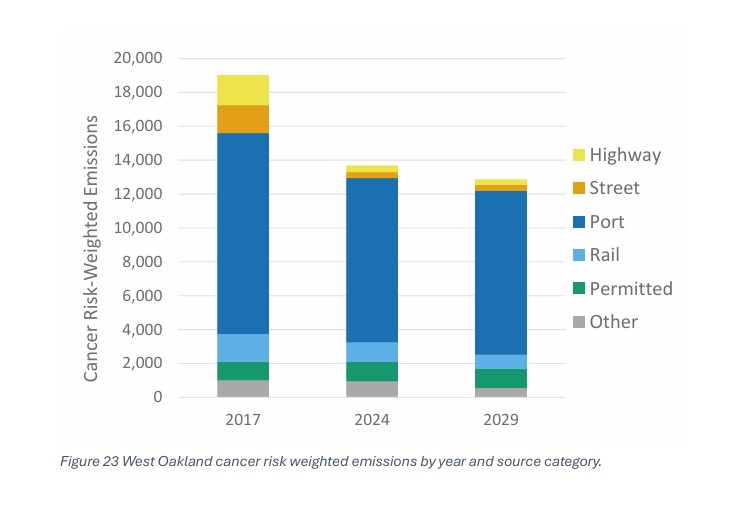
Figure 2: West Oakland Cancer Risk-Weighted Emissions by Year and Source Category (from Table 23, West Oakland Community Action Plan, Fifth Year Annual Report, Oct 9, 2024)
- The improvement in cancer risk if the truck ban is lifted is very small compared with the reduction in cancer risk due to improvements in the diesel fleet between now and 2035. The Caltrans Study found that overall excess cancer risk in the environmentally burdened communities is expected to reduce from 28 cases per million currently to 9 cases per million, with the truck ban still in place. If the truck ban is repealed, the 2035 number reduces to 8 cases per million. The difference between 9 and 8 cases per million is “at or near the resolution of the reported values”. In other words, the amount of change predicted is close to the margin of error and is insignificant.
- 2026 vs. 2021
The Caltrans Study uses CalEnviroScreen scores from 2021. See Air Quality Memo p.4. New data was published in 2026 that shows a significant improvement in West Oakland scores (See Figure 3 below) suggesting that strategies to improve air quality in West Oakland are successful.
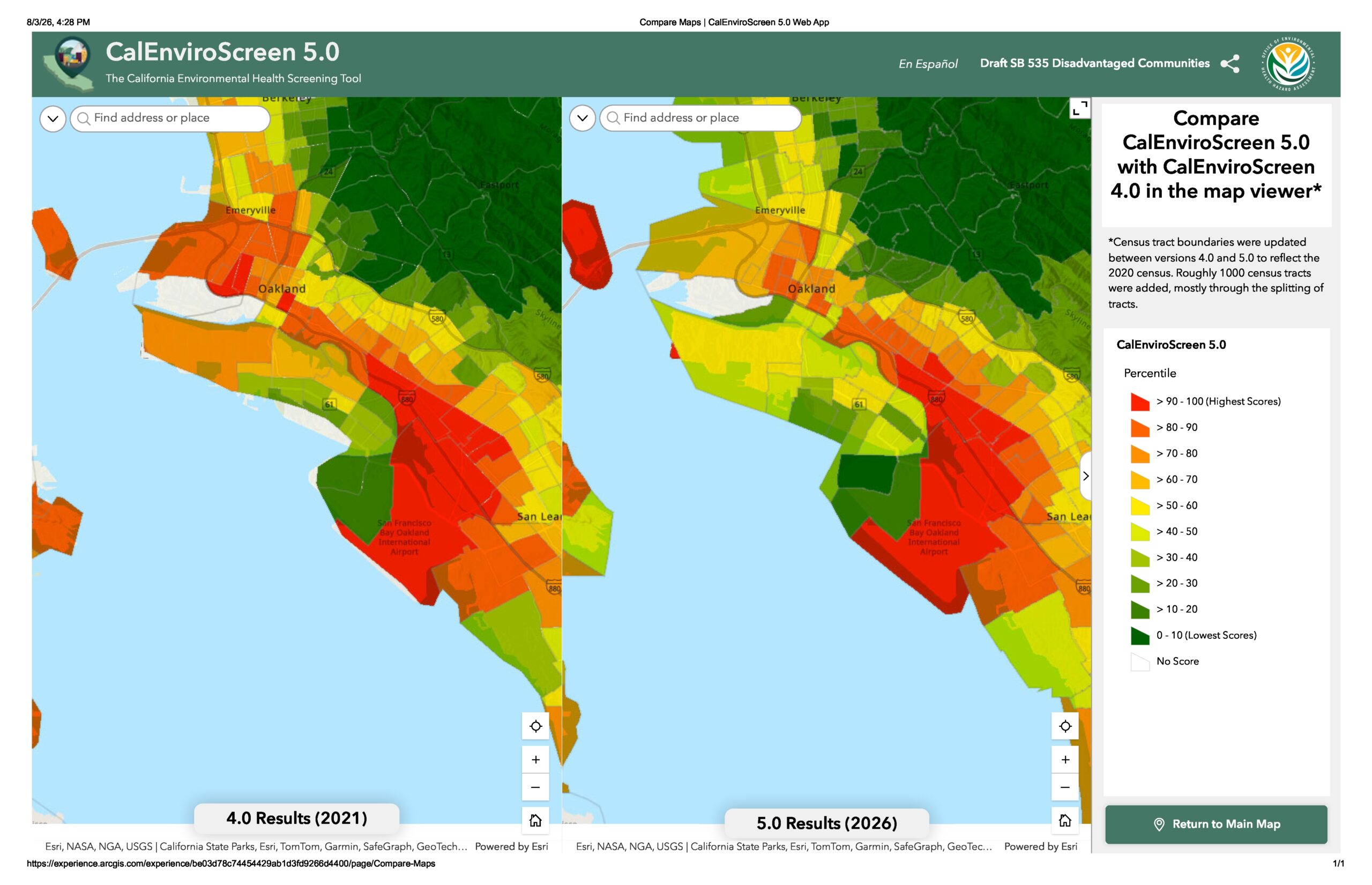
Figure 3: Caltrans used data from CalEnviroScreen 4.0 (left). 5.0 (right) shows significant improvement in West Oakland between 2021 and 2026.
3. Demographics
The Caltrans results do not mention the actual numbers of people who live close to the freeways. They only talk about percentages of the population of the census tracts. Therefore, we included the findings reported in the Skyrak Demographics Study to provide population data. The Skyrak study is more precise than the Caltrans Study because it evaluates the population block by block instead of using census tracts, which is the method used by Caltrans. (The average population of the census tracts close to I-880 and I-580 is about 4,000. The average population of a census block in the same area is about 90. Thus, the Skyrak study is about 45 times more precise than the Caltrans Study).
- The Caltrans study states that 72% of I-880 residents live in Equity Priority Communities (EPCs), vs. 52.3% of I-580 residents (see Equity ToolKit Chapter 02). If we convert these percentages to actual people who live near each freeway, we see that 25,700 people live in EPCs within 1,000 ft. of I-880, and 33,000 live in EPCs within 1,000 ft. of I-580. See Table 1, below. The bottom line is that if trucks are allowed on I-580, this will more than double the number of people in EPC’s exposed to truck traffic.
- The Caltrans Study shows that there are 41 Sensitive Receptor locations (schools, pre-schools, day-care centers, senior centers, hospitals, and health clinics) within 1,000 ft. of I-880, compared with 72 within 1,000 ft. of I-580. (Traffic Memo, p.22). Note that these numbers are slightly different from the numbers quoted in the Equity ToolKit (40 vs. 70). In either case, the conclusion is clear – there are a lot more sensitive receptors along I-580 than along I-880.
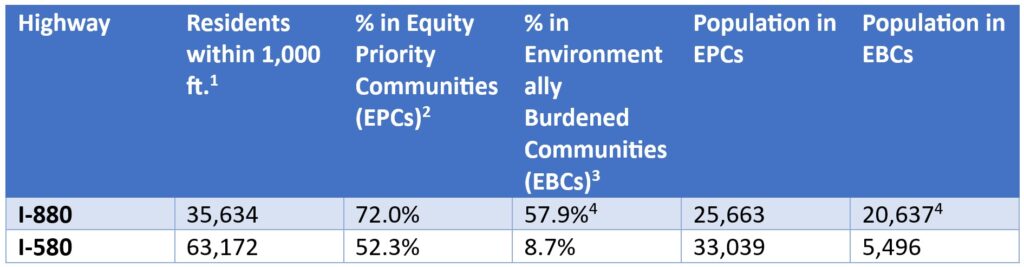
Table 1: Population of Equity Focus Areas close to Freeways
Notes for Table 1:
- From Table 4-1 of the Skyrak Demographics report.
- From Chapter 02 of the Equity Toolkit.
- From Chapter 02 of the Equity Toolkit
- Includes Census Tracts in West Oakland which no longer meet CalEPA’s definition of an EBC based on the 2026 CalEnviroScreen data. (The CES percentile for some of the West Oakland census tracts is now below 70). If those tracts (total population of about 15,000) are removed, the EBC population within 1,000 ft. of I-880 reduces to between 7,000 and 10,000. (This is a range because CalEnviroScreen does not report on a Census Block level, only a Census Tract level.)
4. Race
There are more people of color living within 1,000 ft. of I-580 than within 1,000 ft. of I-880. There are twice as many people who identify as black living within 1,000 ft. of I-580 than within 1,000 ft. of I-880. (See Tables 4-5 and 4-7 of the Skyrak Demographics Study.) Moving trucks from I-880 to I-580 will expose a lot more people of color, and black people especially, to increased truck traffic.
5. The Caltrans Study does highlight some upside to repealing the truck ban as follows:
- Truck journeys on I-880 reduce from 10,700 per day to 6,900 per day.
- Truck journeys on I-238 reduce from 7,400 per day to 3,300 per day.
- Truck journeys on I-980 reduce from 900 per day to 600 per day.
- Truck journeys on some local streets would be reduced:
- 7th street would reduce from 2810 to 2500 trips per day.
- Telegraph Ave between Ashby and Claremont would reduce from 360 to 170 trucks per day.
- Telegraph between 55th and 51st streets would reduce from 240 to 120 trucks per day.
- Aggregate truck travel times throughout the study area would reduce by 100 hours per day (2%) if the truck ban is repealed. (Traffic Analysis, Table 27).
We believe that these apparent benefits do not justify the damage that will be caused to hundreds of thousands of East Bay residents by repealing the truck ban.