Justice
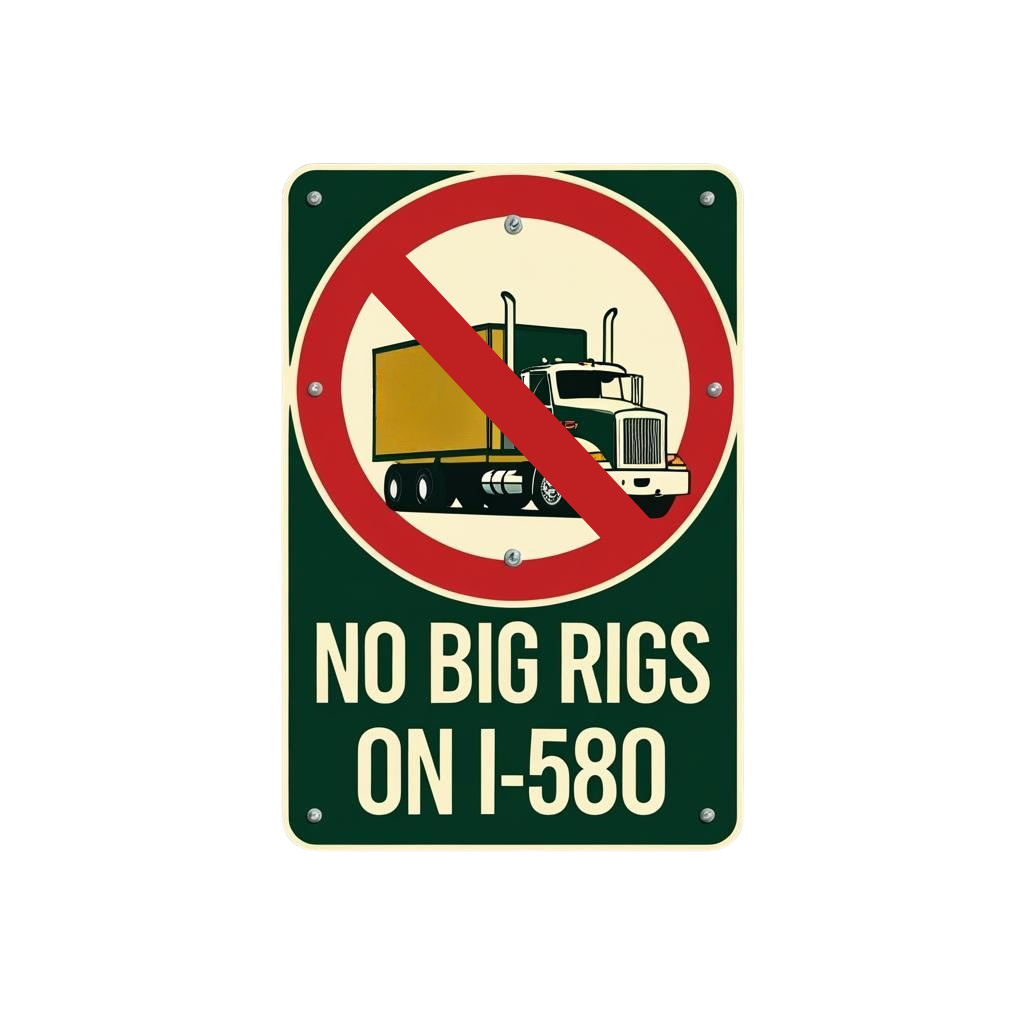
Hundreds of houses were demolished, and families uprooted, to build the I-580 Freeway. Lakeshore Homes alone lost 160 houses. In return, the State committed to keep trucks off the freeway.
Unsuitability of I-580 and Highway 13 for Large Trucks
Currently, trucks greater than 9,000 pounds cannot use I-580 from Grand Avenue to Foothill Boulevard. See map below. If the truck ban is lifted, trucks weighing up to 80,000 pounds will be free to travel anywhere on I-580 and the local feeder highways, shown in yellow on the map. Also, trucks will use local routes, such as High Street and Fruitvale Avenue, to cut through from one freeway to another, especially during times when one of the freeways is congested. These highways and roads are all in non-industrial areas. They are bordered by hospitals, schools, apartment buildings, parks and residential areas. The highways have tight curves (e.g. I-580 at Grand Avenue), and steep hills (I-580 at Park Boulevard; SR 13 at Redwood Road). These roads are not suitable for huge trucks.
If the truck ban is overturned, the increased traffic congestion and noise pollution caused by the hills and tight curves will be immense.

SAFETY
- Big Rig Trucks on I-580 will exacerbate congestion and create pollution, unmitigated noise, vibration and safety risks. Importantly, accidents with heavy trucks account for 12% of passenger vehicle fatalities.
- A Caltrans spokesman has confirmed that overturning the ban will enable big rig trucks to avail themselves of “cut through traffic” on our city streets as trucks find new routes to avoid congestion. This creates a hazard to pedestrians in our neighborhoods.
more people live alongside I-580 than alongside i-880
Skyrak Engineering Services recently published a report on the demographics of the I-880 and I-580 corridors. Skyrak reported the following facts:
- Rerouting trucks from I-880 to I-580 would allow heavy trucks to travel within a half mile of 235,000 residents who were not previously exposed to truck traffic.
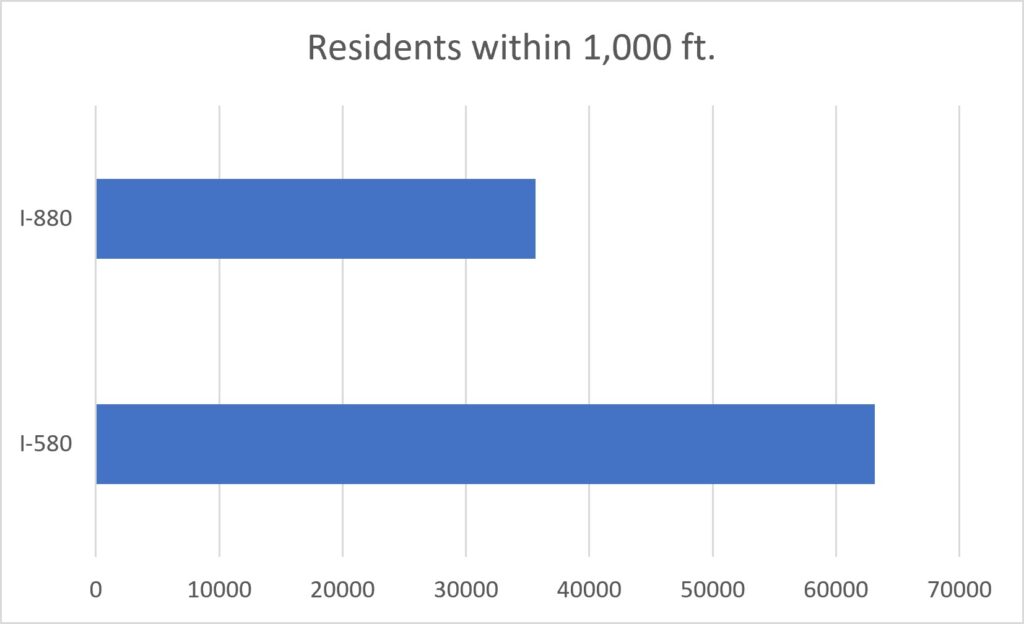
- 77% more people live within 1,000 ft. of Highway I-580 between the MacArthur Maze and I-238 than live within 1,000 ft. of Highway I-880 between the MacArthur Maze and I-238.
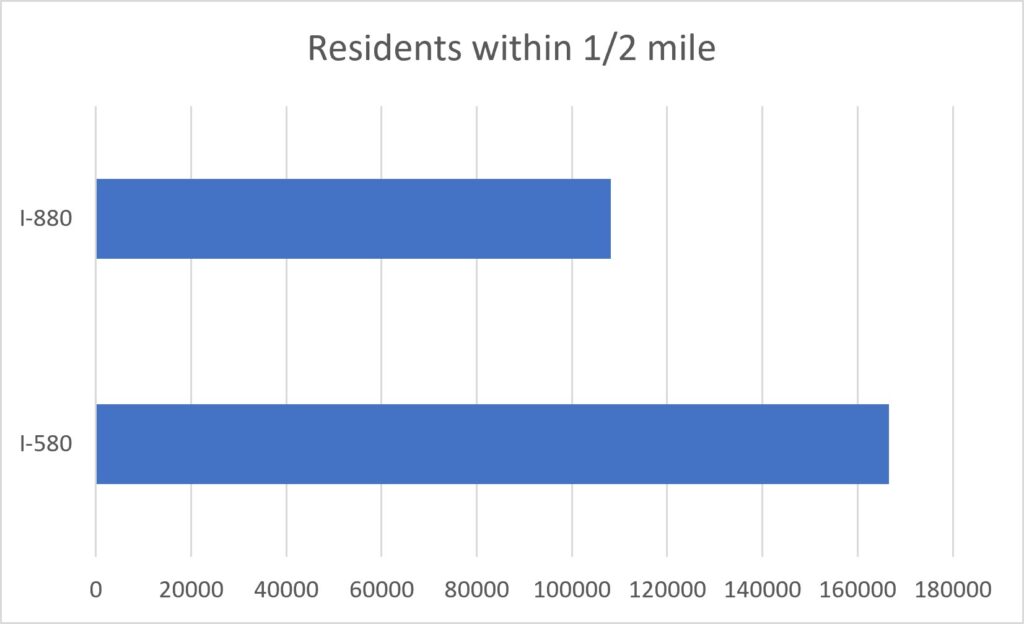
- 54% more people live within ½ mile of Highway I-580 between the MacArthur Maze and I-238 than live within ½ mile of Highway I-880 between the MacArthur Maze and I-238.
- There are five hospitals located within ½ mile of the I-580 freeway that will be exposed to truck traffic if the ban is removed. (six if you include Alta Bates on Ashby Ave (SR-13) in Berkeley). This compares to one hospital within ½ mile of I-880.
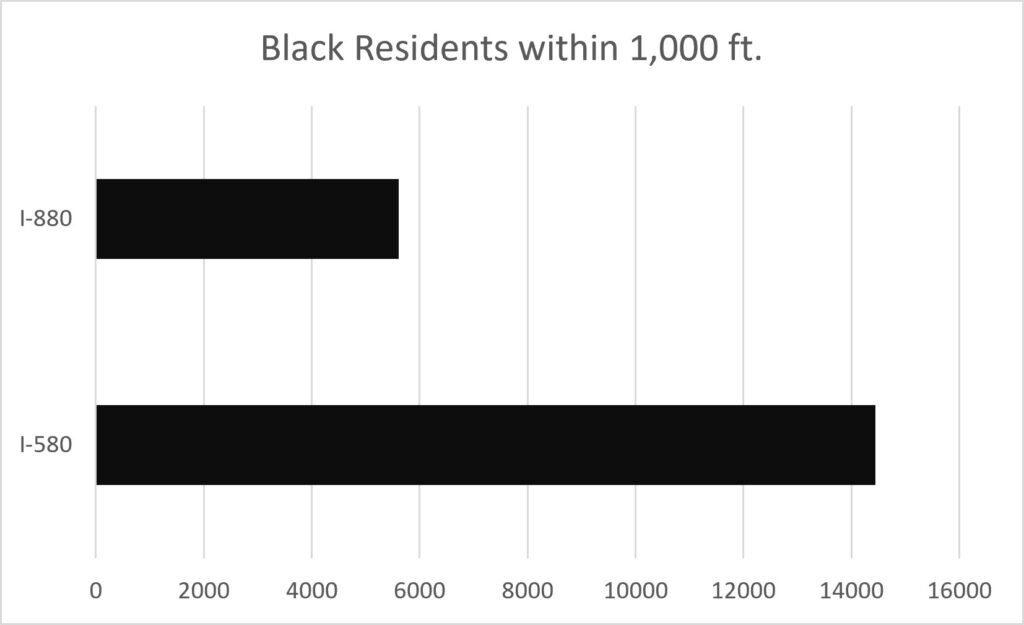
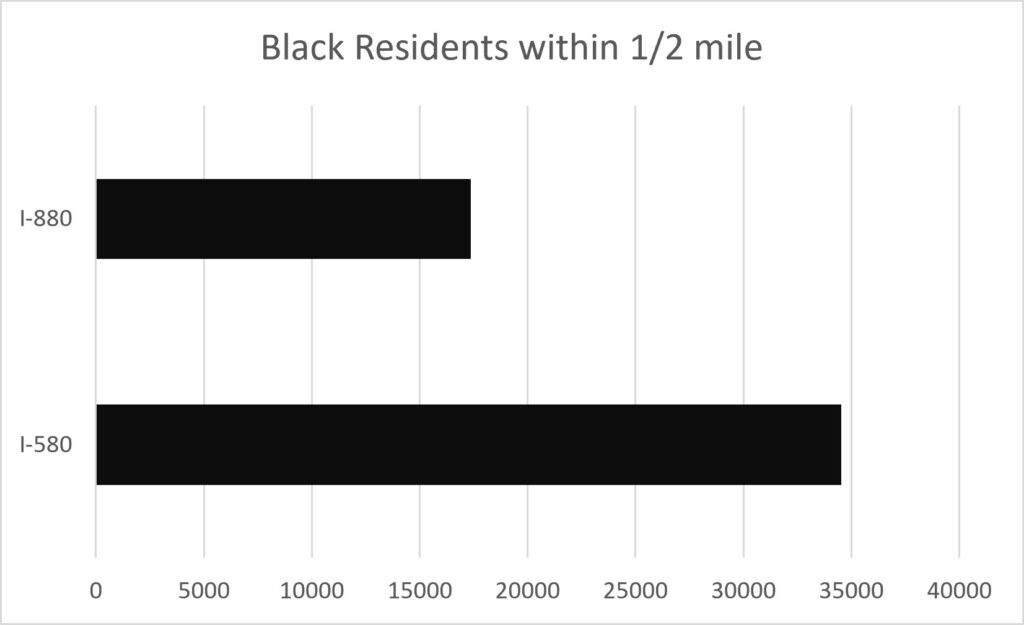
- Twice as many people who identify as black live within 1,000 ft. of I-580 as live within 1,000 ft. of I-880. The same holds true for people living within ½ mile of the highways.
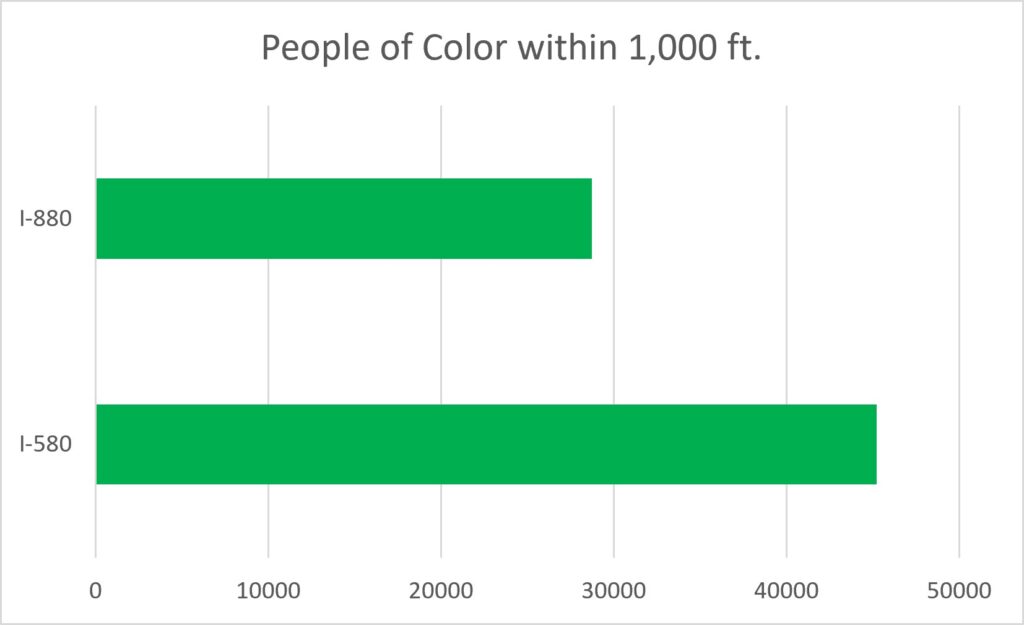
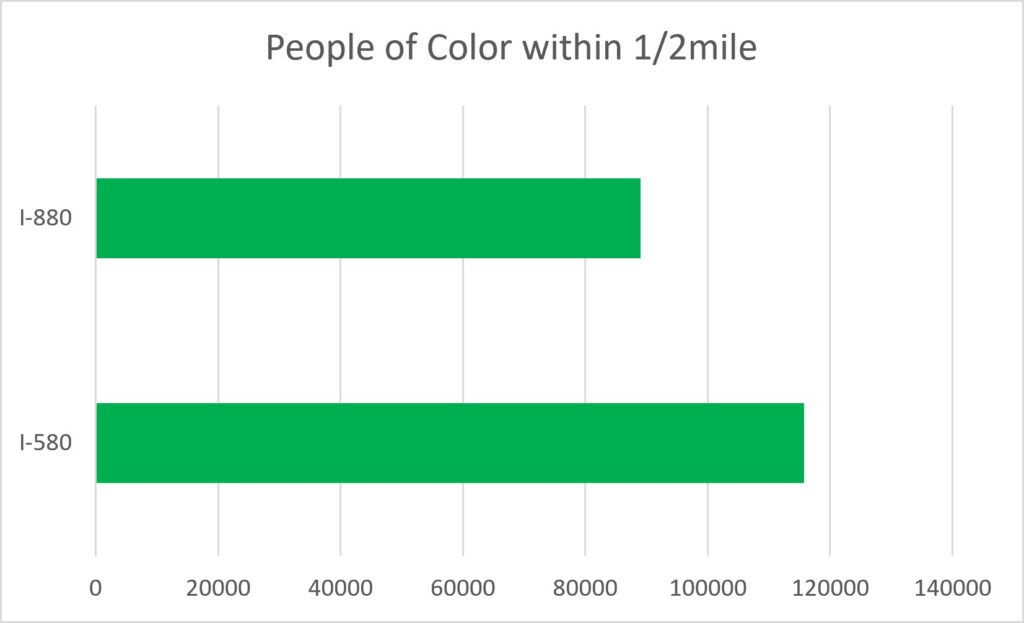
- More people of color live along the I-580 corridor than along the I-880 + I-238 corridor. (depending of the distance, at least 8%, more and as high as 58% more)
- From what we currently know of the ongoing Caltrans Truck Access demographic study, the Skyrak study is more accurate because it operates at the census block level. Because the Caltrans Study uses 2025 ACS data, the best location accuracy that data can achieve is the block-group level, which is approximately 30x less precise than the block level data used by Skyrak.
There are better ways of reducing pollution in underserved areas
As a method of reducing air pollution in West Oakland and East Oakland, moving trucks from I-880 to I-580 is highly ineffective for two reasons:
1. Trucks are not a big source of pollution in the target areas (see below), and
2. The harm caused by truck traffic to the hundreds of thousands of people who live, go to school, and travel to hospitals along the I-580 and SR 13 corridors far outweighs the benefit to the underserved areas. The ongoing Caltrans Truck Ban Study should confirm this comparison, but we are concerned that the limited nature of the study, coupled with the bias of the Technical Advisory Committee towards lifting the ban, will fail to adequately evaluate the harm caused by lifting the ban, and will therefore recommend that the truck ban should be overturned.
3. We believe that there are more effective and less damaging ways of reducing air pollution in underserved areas. The Bay Area Air District (BAAD) has published a report annually summarizing the West Oakland Community Action Plan (WOCAP), which serves as the Community Emission Reduction Plan as required by AB617. The 2025 annual report contains the following three charts, that show the the known effects of highway-sourced emissions and projected effects in the future on local air quality:
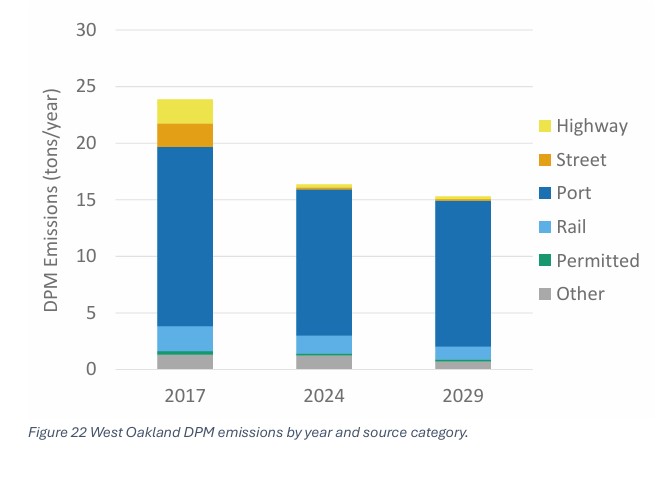
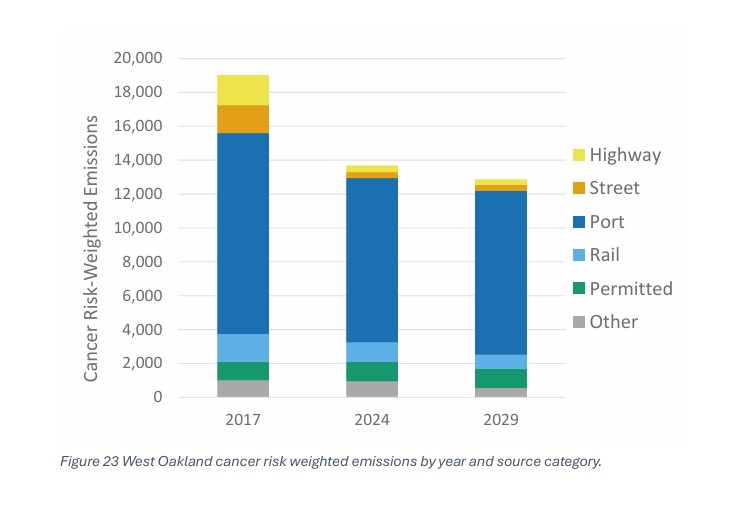
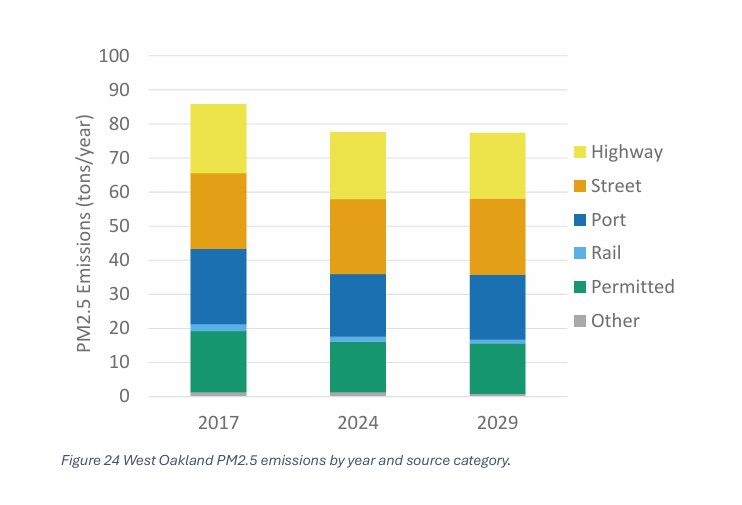
These charts show that the BAAD is doing a great job in improving air quality in West Oakland. In fact, if you go back further, to 2010, the reduction in Alameda County pollution from diesel trucks has been outstanding, resulting in an approximate 90% reduction:
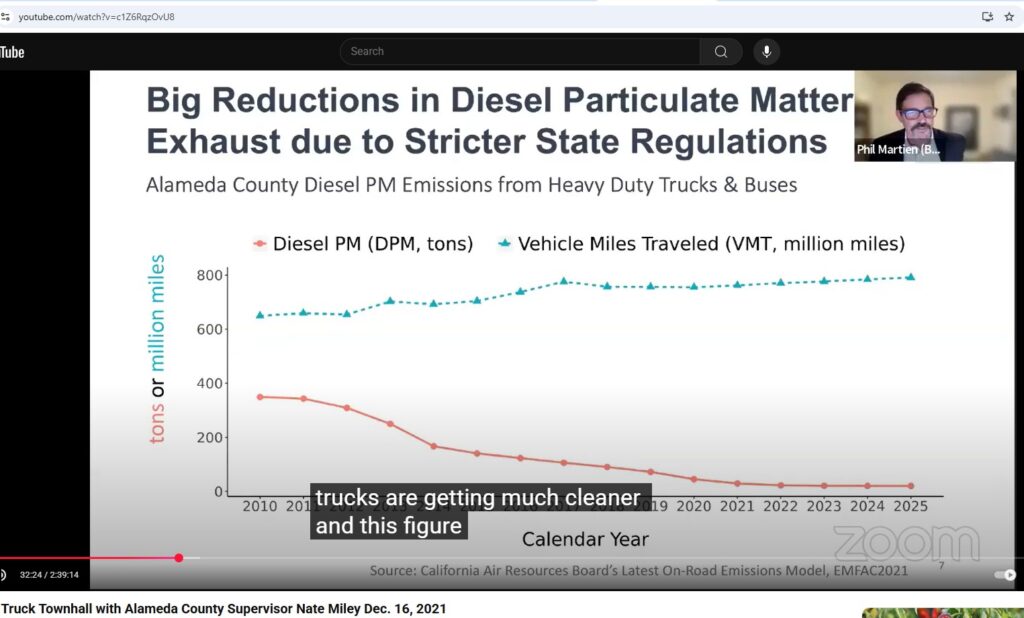
All this means that air pollution from trucks is nowhere close to the problem it was in the early part of this century, and that if we really want to tackle air pollution in West and East Oakland, we need to go after the biggest sources: Port and Airport operations, railroad links, and industry along I-880. We should be trying to replace diesel locomotives with electric, continue to upgrade equipment at the Port with low- or-zero-emission equipment, look at opportunities to reduce air pollution at the Airport, and require that industry engage in practices and controls that reduce emissions (e.g., scrap yards). Moving trucks from I-880 to I-580 will only result in a small improvement in West and East Oakland air pollution.
WE support the Truck Ban but Who Benefits from its Removal?
- The California Trucking Association (CTA), a freight industry lobbying group, has a longstanding interest in dismantling this ban which will allow 80,000 lb. big rig traffic on I-580, Highway 13 and other East Bay highways and streets.