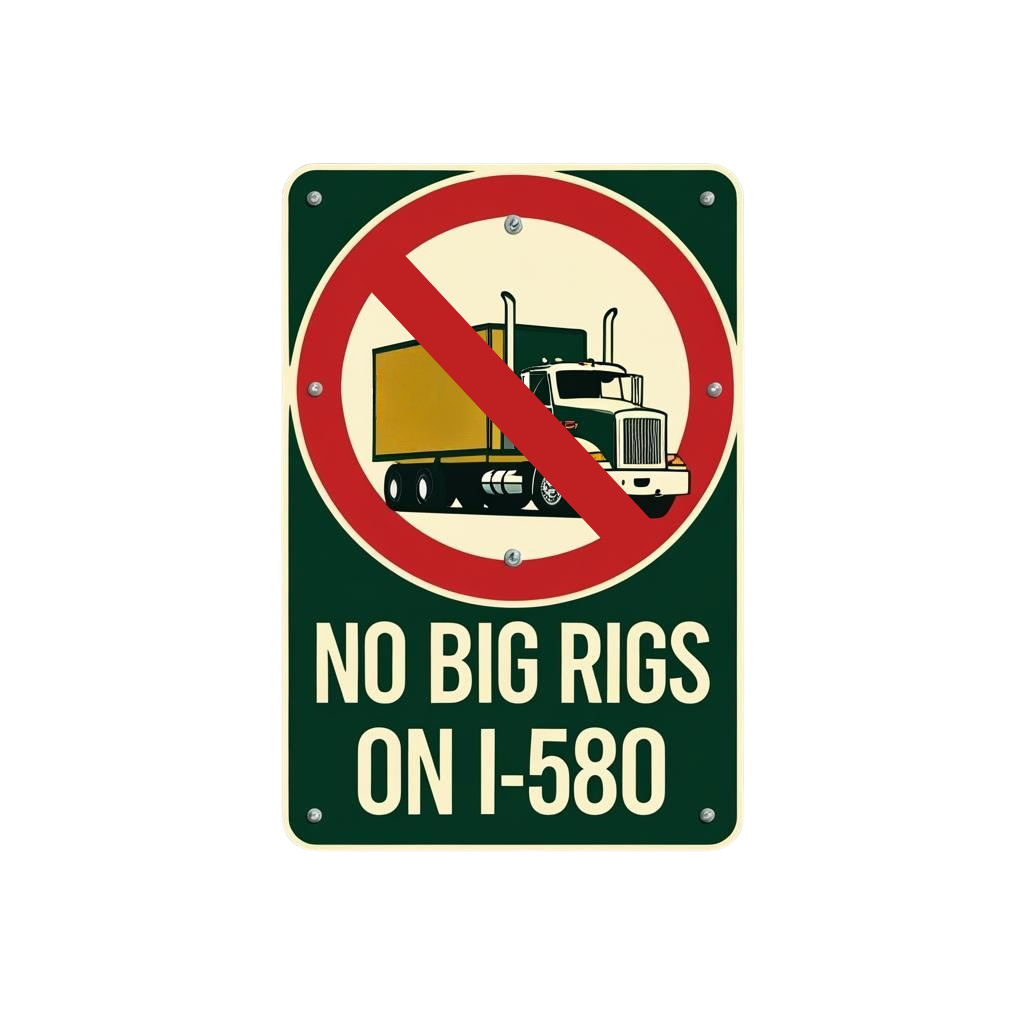
Understanding the Caltrans Study: Why It Matters
Caltrans is conducting a study to assess the effects of introducing heavy trucks on Interstate 580. The ban on heavy trucks has been in place since 1951 (on MacArthur Boulevard), and the truck ban was a commitment by the State when the freeway was constructed in the 1960s.

Why are large trucks Banned on I-580?
Because of the residential and small business nature of the I-580 corridor, big rig trucks have been banned since the freeway opened in 1963. This ban was requested by the City of Oakland and approved by the Federal Highway Administration and Caltrans. The ban followed the truck prohibition on MacArthur Blvd, established by the City in 1951.
Why are large trucks being considered for I-580?
The California Trucking Association (CTA) has a longstanding history of lobbying Caltrans to abandon the truck ban to improve freight efficiency. The Bay Area Air District is required by law to develop plans to reduce air pollution in target areas (West Oakland and East Oakland) to improve racial equity. Both of these goals are being evaluated in the Caltrans Study, but we have serious concerns about the safety, congestion, and noise pollution effects on the neighborhoods that will be affected. For more information see Truck Ban Study
Doesn’t the truck ban affect only a short length of i-580?
No. Although the truck ban applies only to I-580 between Grand Avenue and Foothill Boulevard, the effect is region-wide. See the map below for roads that will experience a significant increase in truck traffic if the ban is overturned.

Is I-580 the only California Freeway that bans Big Rigs?
No. Trucks are banned on several California freeways, including Highway 85 in the South Bay. The Highway 85 ban mirrors the I-580 ban by restricting trucks over 9,000 pounds. Similarly to I-580, the Highway 85 truck ban was a condition of the freeway construction, because it passes through residential neighborhoods, and alternative truck routes were available. For more information, see https://dot.ca.gov/programs/traffic-operations/legal-truck-access/restrict-route-85 . This raises an important question: If Caltrans is allowed to remove the I-580 truck ban, will it also seek to remove the Highway 85 truck ban?
What ENVIRONMENTAL impacts could this proposal cause FOR OAKLAND NEIGHBORHOODS?
Freeway noise will increase dramatically, especially where there are tight curves and steep hills on Highway 13 and I-580. This will have a significant impact on the schools, hospitals, parks and neighborhoods that are adjacent to I-580 and Highway 13.
Would Removing the truck ban reduce air pollution along the I-880 Corridor?
Unlikely. Opening I-580 to big rig trucks will increase the number of trucks traveling through Oakland to/from the Port as the trucking industry maximizes the additional roadway capacity from I-580. Repealing the ban would knowingly increase the number of people exposed to truck pollution.
how will allowing big rigs on i-580 affect neighborhood safety?
Increased truck traffic can lead to more accidents on the freeway and endanger pedestrians and cyclists where the on and off ramps intersect with city streets.
The trucks will just be on the Freeways, Right?
Wrong. Currently, there are almost no big trucks on Highway 13. If the truck ban is overturned, there will be many trucks that will now use Highway 13 as a through route from 80 and 24 to 580 and beyond. Also, Ashby Avenue in Berkeley could see an increase in through trucks, as could streets used as “cut-throughs” between freeways, such as Park Blvd./14th Ave., Fruitvale Ave., High Street, 98th Ave., Dutton Ave., Hesperian Blvd., and Fairmont Drive. Moreover, trucks will likely use city streets adjacent to the highways to park while the drivers take mandated rest breaks.
Isn’t I-580 a Designated Scenic Highway? How can trucks be allowed?

Yes – between Highways 24/I-980 and the Oakland/San Leandro border, I-580 is an officially designated state scenic highway. This means that Caltrans and the City of Oakland are responsible to protect land use adjacent to the highway from certain types of development. However, trucks are allowed on scenic highways. But there is no doubt that I-580 will become less scenic if the truck ban is removed.